
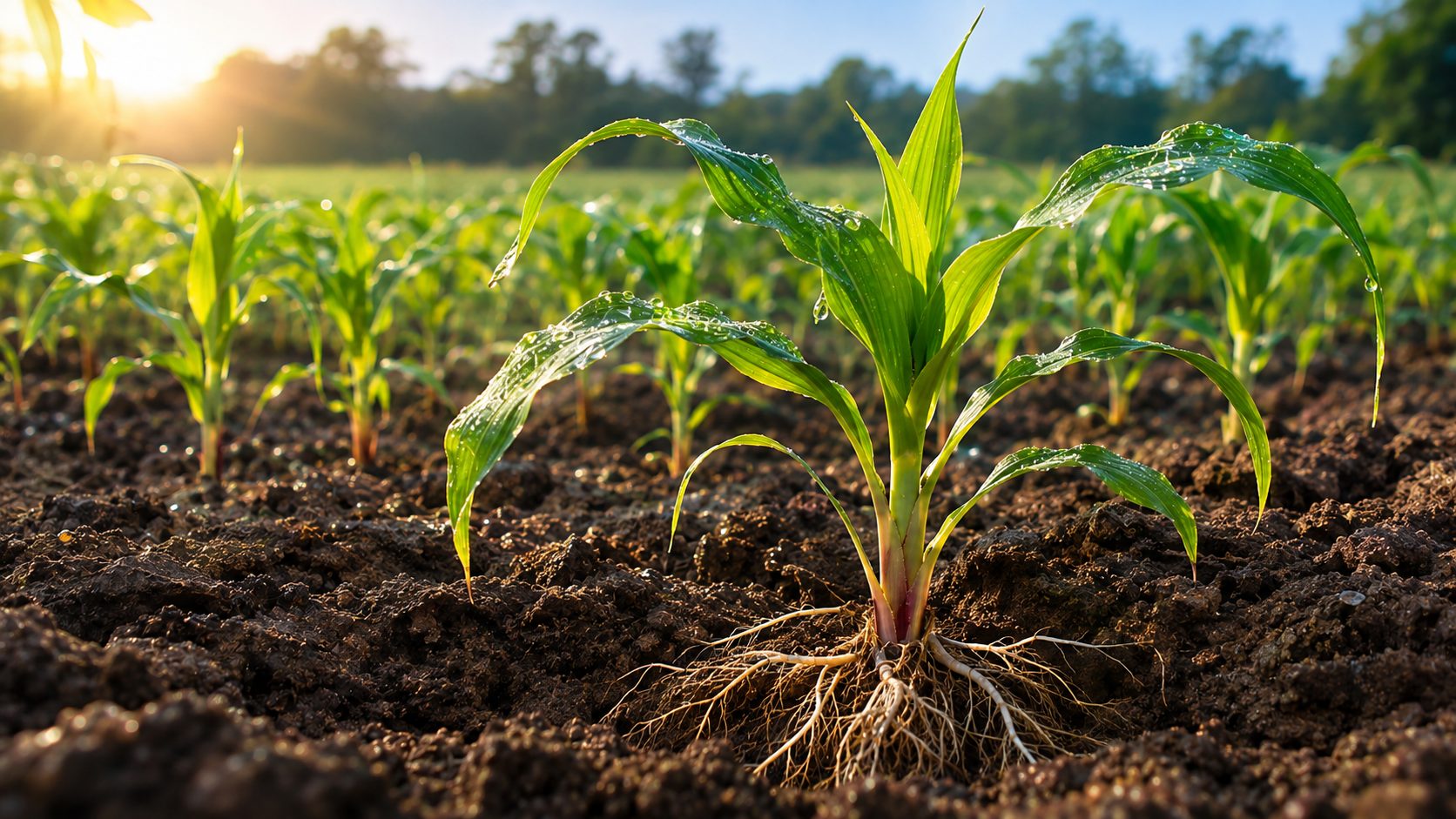
The missing link between nutrient efficiency, soil moisture, and sustainable agriculture.
Agriculture is entering an exciting period of technological advancement. From nanofertilizers and precision nutrient delivery to intelligent irrigation systems, innovations are changing how growers manage their crops.
Much of this progress focuses on a familiar challenge: How can we deliver more nutrients to plants while minimizing waste?
But there is another question that deserves just as much attention.
What happens when the nutrients are there, but the water isn’t?
A fertilizer may be scientifically advanced, carefully formulated, and applied at precisely the right rate. Yet its effectiveness still depends on the conditions surrounding the plant’s roots.
And one of the most important of those conditions is water availability.
The Relationship Between Water and Nutrient Uptake
Plants do not simply absorb fertilizer because it has been applied to the soil.
Most mineral nutrients must first become available in the soil solution before they can be absorbed by plant roots.
Three principal mechanisms deliver nutrients to the root surface:
- Mass flow: Nutrients dissolved in soil water move toward roots as plants absorb water.
- Diffusion: Nutrients move through the soil solution from areas of higher concentration toward areas where roots have depleted them.
- Root interception: Growing roots encounter nutrients as they explore the soil.
Water availability influences these processes, particularly mass flow and diffusion.
When soil moisture becomes insufficient, nutrient movement can slow, root growth may become restricted, and the plant’s ability to acquire essential elements may decline.
This means that even when soil tests indicate adequate fertility, plants may struggle to access those nutrients under water-limited conditions.
Nutrient availability in the soil does not always translate into nutrient availability to the plant.
Nanotechnology: A New Approach to Nutrient Efficiency
Nanotechnology is introducing new possibilities for agricultural nutrient management.
Nanofertilizers, nano-encapsulation, and specialized delivery systems are being investigated for their ability to improve nutrient-use efficiency, regulate nutrient release, and potentially reduce losses.
These technologies represent an important direction for agricultural research.
However, improved fertilizer formulation does not eliminate the plant’s physiological dependence on water.
A controlled-release fertilizer may regulate how nutrients become available, but root absorption still requires favorable conditions in the root zone.
Similarly, precision fertilization can improve when and where nutrients are applied, yet periods of inadequate soil moisture can still limit their utilization.
For this reason, nutrient management and water management should not be considered separate strategies.
They are interconnected components of crop productivity.
The Root Zone: Where Water and Nutrition Meet
The root zone is one of the most important environments in agricultural production.
It is where the plant accesses water, absorbs mineral nutrients, interacts with soil microorganisms, and responds to changing environmental conditions.
When moisture fluctuates dramatically between irrigation or rainfall events, plants may experience alternating periods of favorable growth and water stress.
These fluctuations can affect nutrient uptake, photosynthesis, root activity, and overall plant development.
Maintaining adequate soil moisture for longer periods may help create more favorable conditions for nutrient absorption.
Importantly, this does not mean keeping soils continuously saturated. Excess water can restrict root-zone oxygen and contribute to nutrient losses.
The objective is to maintain a suitable balance between water availability, aeration, and nutrient supply.
Water-Retaining Polymers: Supporting the Environment Around the Roots
While nanotechnology focuses on innovations at an extremely small scale, other material technologies address agricultural efficiency through different mechanisms.
One example is the use of superabsorbent polymers (SAPs).
These materials can absorb and retain substantial quantities of water relative to their own mass. Depending on their formulation and soil conditions, they may subsequently release some of that stored moisture as the surrounding soil dries.
When properly selected and applied, water-retaining polymers may help:
- Increase water retention in the root zone.
- Moderate fluctuations in soil moisture.
- Extend moisture availability between irrigation events.
- Reduce the intensity of water stress during dry periods.
- Support conditions favorable to continued root activity and nutrient uptake.
Their effectiveness depends on soil texture, salinity, application rate, crop requirements, and irrigation practices.
Water-retaining polymers do not replace fertilizers, irrigation, or sound soil management. Instead, they offer an additional tool for improving the conditions in which these practices operate.
This is where technologies such as Hidrokeeper® and EF Polymer can play a complementary role.
Hidrokeeper® is a synthetic superabsorbent polymer designed to absorb and retain water within the soil, making a portion of that stored moisture available as surrounding conditions become drier. Its absorption, release, and recharge cycle can help moderate fluctuations in root-zone moisture between irrigation or rainfall events.
EF Polymer offers a different approach through an organic-based water-retaining material manufactured from fruit-derived raw materials. It is designed to improve moisture retention in the soil and support water availability around plant roots.
Although their compositions differ, both technologies address a common challenge: maintaining favorable moisture conditions in the root zone.
By helping manage water availability, these materials may indirectly support nutrient movement and uptake, particularly during periods when declining soil moisture would otherwise limit these processes.
Complementary Technologies, Not Competing Solutions
The future of agricultural efficiency may not depend on a single breakthrough.
It may come from combining technologies that address different limitations in the plant-growing environment.
Consider three complementary approaches:
- Advanced fertilizers aim to improve nutrient formulation, availability, and delivery.
- Precision agriculture helps growers determine when, where, and how much water and fertilizer to apply.
- Water-retention technologies seek to improve moisture management in the root zone.
Together, these approaches have the potential to create more integrated crop-management systems.
The principle is straightforward: improving fertilizer efficiency requires attention not only to the nutrients being supplied, but also to the environment in which plants absorb them.
Qemi International: Looking Beyond the Fertilizer
At Qemi International, we believe agricultural innovation should address the practical challenges growers face in the field.
Through technologies such as Hidrokeeper®, a synthetic superabsorbent polymer, and EF Polymer, an organic-based water-retaining polymer developed from fruit-derived raw materials, we work with solutions intended to improve soil moisture management.
These products represent different approaches to water retention, but they share an important objective: helping growers manage water availability in the root zone.
Neither should be confused with nanofertilizer technology. Rather, their potential contribution lies in complementing nutrient-management programs by addressing the water side of the equation.
Because supplying nutrients is only part of the challenge.
Creating suitable conditions for plants to use them is equally important.
The Future: Managing Resources as an Integrated System
As agriculture faces increasing pressure from water scarcity, climate variability, rising input costs, and the need for greater productivity, the conversation must move beyond individual products.
Future advances will increasingly depend on understanding how soil, water, nutrients, roots, and technology interact.
Nanotechnology may help improve fertilizer delivery.
Digital agriculture may improve application decisions.
Water-retaining materials may help manage soil moisture availability.
Each addresses a different part of the agricultural system, and none is universally effective under all field conditions.
The opportunity lies in combining appropriate technologies based on crop needs, soil characteristics, and local growing conditions.
Perhaps the next major advancement in fertilizer efficiency will not come from fertilizer alone, but from better management of the water that makes nutrient uptake possible.
Qemi International — We formulate to need.
Scientific References
- University of Florida IFAS — Nutrient Supply to Plant Roots — Explains mass flow, diffusion, and root interception.
- Review of Research and Innovation on Novel Fertilizers for Crop Nutrition (2025) — Examines emerging fertilizer technologies and evidence gaps.
- Effects of Superabsorbent Polymers on Crop Yield and Water Productivity (2023) — Global meta-analysis of agricultural SAP research.
- Nano-agrochemical Use in Sustainable Agriculture and Environmental Protection (2026) — Reviews the opportunities and environmental considerations of nano-agrochemicals.