PFAS in Water: Why There Is No “One-Chemical Solution” And How to Build the Right Treatment Strategy
The Reality of PFAS
Per- and polyfluoroalkyl substances (PFAS)—often called “forever chemicals”—are among the most persistent contaminants in modern water systems. Their chemical stability makes them extremely difficult to break down, which means traditional treatment programs are not enough.
PFAS are not eliminated with a single additive or a generic chemical program. They require a treatment strategy with two different goals:
- Remove/separate PFAS from water
- Destroy PFAS in the concentrated waste stream
Today, most real-world systems focus on removal, because scalable destruction technologies remain limited and highly energy-intensive.
So the real question is not “What product removes PFAS?”
For water treatment, the most established technologies are:
- Granular activated carbon (GAC)
- PFAS-selective ion exchange resins
- High-pressure membranes such as reverse osmosis/nanofiltration
The EPA identifies these as the main effective approaches now in use (US EPA).
For Qemi, the strongest and most credible position is this:
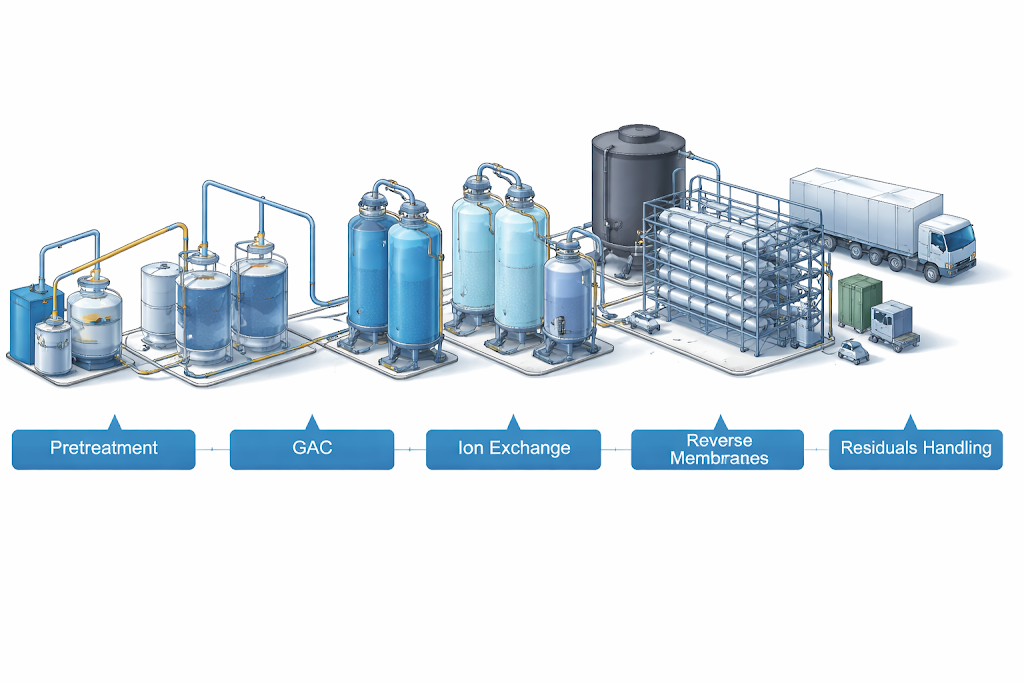
Qemi can help design the treatment program around PFAS removal, but PFAS elimination usually requires a full treatment train, not just one chemical.
That means combining:
- Pretreatment
- The right separation technology
- A disposal/destruction plan for the spent media or concentrate
EPA’s guidance is clear that removal technologies create residuals that still have to be managed properly (US EPA).
A Practical Qemi-Style Answer
How do we eliminate PFAS?
- Reduce fouling and stabilize the system with the right pretreatment chemistry.
- Use the proper PFAS removal technology—typically GAC, ion exchange, or membrane separation—based on water quality, PFAS profile, and discharge goals.
- Handle the captured PFAS through an approved residuals strategy, because removal is not the same as destruction (pfas-1.itrcweb.org).
Where Qemi Fits
- Pretreatment support: Coagulants, flocculants, antifoams, and membrane-support chemistries can improve system performance, protect downstream equipment, and reduce fouling.
- Treatment-train selection: Helping customers determine whether GAC, IX, or RO/NF is the better fit.
- Residuals strategy: Identifying that spent carbon, resin, or RO concentrate still needs compliant downstream handling (pfas-1.itrcweb.org).
PFAS Removal Technologies
Granular Activated Carbon (GAC)
- Effective for long-chain PFAS
- Proven, widely adopted technology
- Requires replacement or regeneration
Ion Exchange Resins (IX)
- Higher capacity and faster kinetics
- Strong performance on short-chain PFAS
- Compact system footprint
Reverse Osmosis / Nanofiltration (RO/NF)
- Broad PFAS rejection
- High-quality treated water
- Produces a concentrated waste stream requiring management
Where Most Programs Fail
The industry often looks for a single solution.
PFAS don’t behave like conventional contaminants. They move, persist, and concentrate. That means:
- Coagulation alone is not enough
- A single filtration step is not enough
- A “catalog product” is not enough
PFAS control is a system—not a product.
The Qemi Approach: Build the Treatment Train
At Qemi International, we don’t sell chemicals hoping they work. We design solutions that do.
1. Pretreatment That Protects the System
Before PFAS removal even begins:
- Coagulants & flocculants reduce organics and solids
- Antifoams stabilize operations
- Process chemistries protect membranes and extend media life
Result: Better efficiency, lower cost, longer system performance
2. Technology Selection Based on Reality
Every system is different. We evaluate:
- PFAS profile (long-chain vs short-chain)
- Water chemistry
- Operating conditions
- Regulatory targets
Then we align the solution:
- GAC
- Ion exchange
- RO/NF
- Or a hybrid system
3. Residuals Management — Where Compliance Happens
Removing PFAS does not make them disappear. They are transferred into:
- Spent carbon
- Loaded resins
- Concentrated membrane reject
And those streams must be handled correctly. This is where true responsibility—and true expertise—comes in.
The Qemi Position
PFAS are not solved with generic chemistry. They require a strategy.
At Qemi, we help customers:
- Build complete treatment programs
- Optimize system performance
- Navigate evolving regulations
- Move beyond “trial and error” into engineered solutions
Final Thought
PFAS demand a different level of thinking:
- Not reactive
- Not generic
- Not one-size-fits-all
PFAS do not disappear. They must be removed, concentrated, and responsibly managed.
That’s the difference between supplying chemicals… and delivering solutions.
Let’s Build the Right Solution
Whether you’re dealing with:
- Municipal water treatment
- Industrial discharge
- Process water optimization
Qemi International is ready to help you design the right PFAS strategy—end to end.
FAQs for PFAS in Water
- What is PFAS?
Persistent “forever chemicals” that resist breaking down in water. - Can one chemical remove PFAS?
No. PFAS needs a full treatment train and proper residuals handling. - Best removal technologies?
GAC, Ion Exchange (IX), RO/NF membranes. - What happens after PFAS removal?
They concentrate in spent media or membrane rejects and need safe disposal. - How does Qemi help?
Provides complete PFAS programs: pretreatment, technology, and residuals management.