
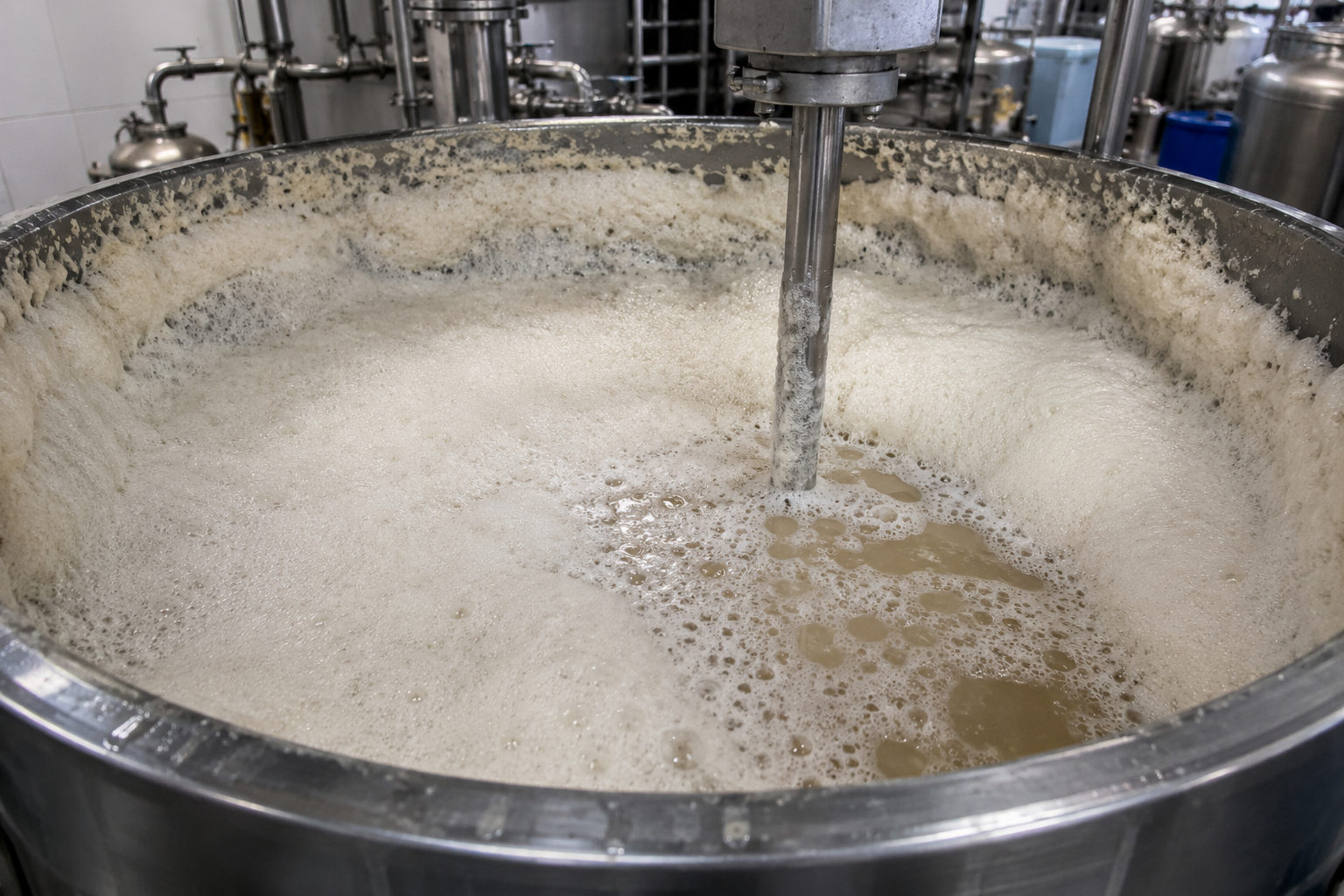
Foam is not just a nuisance on the surface of a tank. In food and beverage processing, it is a direct threat to yield, product quality, regulatory compliance, and equipment lifespan. The right foam control chemicals, applied at the right stage and in the right form, are what separate a smooth production run from one full of stoppages, waste, and rework.
We work with food and beverage manufacturers across multiple continents, and one pattern shows up again and again: foam problems are often underestimated until they become costly. This guide breaks down where foam shows up, why it forms, and how the right defoamer or antifoam selection changes outcomes at every stage of production.
Why Does Foam Form in Food and Beverage Production?
Foam forms when surface-active compounds, including proteins, pectins, saponins, starch degradation products, and humic acids, become trapped between air and liquid interfaces. In food processing environments, these compounds are naturally present in raw materials like sugarcane juice, molasses, fruit extracts, and grain wort.
The problem becomes acute when agitation, heating, fermentation gases, or pumping introduce air into the process stream. Fermentation, in particular, generates carbon dioxide as a direct byproduct of microbial activity. This CO₂ interacts with surface-active agents already present in the liquid, creating foam layers that are both persistent and, in some cases, structurally stable enough to overflow containment vessels.
Foam formation is not random. It is process-specific. Baker’s yeast production, citric acid fermentation, rum and ethanol production, antibiotic manufacturing, and sugar juice processing all have distinct foam profiles based on their raw materials, temperatures, and biological activity. This is why a single foam control product does not work across all applications. Matching the defoamer chemistry to the process is what drives results.
What Is the Difference Between a Defoamer and an Antifoam?
A defoamer is added after foam has already formed, to break it down quickly. An antifoam is added before foam formation begins, to prevent it from building up. Both serve foam control purposes, but they work at different points in the process and often have different chemical compositions.
In practice, many food and beverage operations use both. An antifoam is dosed at the start of a fermentation cycle to suppress initial foam buildup. A defoamer is kept on standby for rapid addition when foam begins to climb unexpectedly, whether due to a temperature spike, a change in raw material composition, or higher-than-expected microbial activity.
Knowing which to use, and when, is part of process optimization, not just chemical purchasing. Our foam control product range includes silicone-based, oil-based, and water-based solutions, formulated for both food-grade and industrial-grade applications.
Where Foam Does the Most Damage in Food Processing
Fermentation Vessels and Bioreactors
Fermentation is where foam control matters most. During the fermentation of ethanol, beer, citric acid, amino acids like glutamic acid, and antibiotics, microbial activity releases CO₂ continuously. When this gas encounters proteins and other surface-active compounds in the broth, foam builds rapidly.
If foam is not controlled, it escapes through vent lines and safety valves, taking product with it. In pharmaceutical-grade fermentation, this is not only a yield loss but also a contamination risk. Bacteria can colonize the overflow lines and re-enter the fermenter, introducing off-flavors, contamination, and potential batch failures. For Baker’s yeast production specifically, foam control directly affects the moisture content and structure of the final dried yeast product.
Our QEMI DF 7911 is specifically formulated for Baker’s yeast applications. For antibiotic and enzyme fermentation, the QEMI DF 210 FG, DF 220 FG, and DF 230 FG series provide food-grade silicone-based performance at very low dosage rates, which matters significantly in regulated production environments.
Sugar Juice Processing and Molasses Handling
Sugarcane juice carries humic acids, pectins, and proteins that foam aggressively during heating in evaporators and during clarification. At the evaporator stage, foam reduces heat transfer efficiency, which means more energy is needed to achieve the same concentration. This is a direct operating cost increase that most facilities never attribute to foam.
Molasses, a byproduct of sugar processing, is used as a fermentation substrate for yeast, ethanol, and rum production. Its high sugar content and organic load make it one of the most foam-prone materials in food processing. Controlling foam in molasses fermentation requires an organic-based defoamer rather than a silicone-based one, because silicone antifoams can interfere with downstream distillation processes.
Our QEMI DF 8322 is an organic-based defoamer designed precisely for molasses fermentation, ethanol production, gasohol processes, and rum production, where silicone contamination of the distillate is not acceptable.
Yeast Whitening and Plasticization
This is an area most foam control suppliers do not address directly. In yeast processing, the appearance and texture of the final yeast product matters to customers. Foam-related byproducts during yeast production can affect color, plasticity, and shelf life of the yeast cake. Our QEMI YP 8035 functions as both a yeast plasticizer and a whitening agent, addressing foam suppression and final product quality together in a single application.
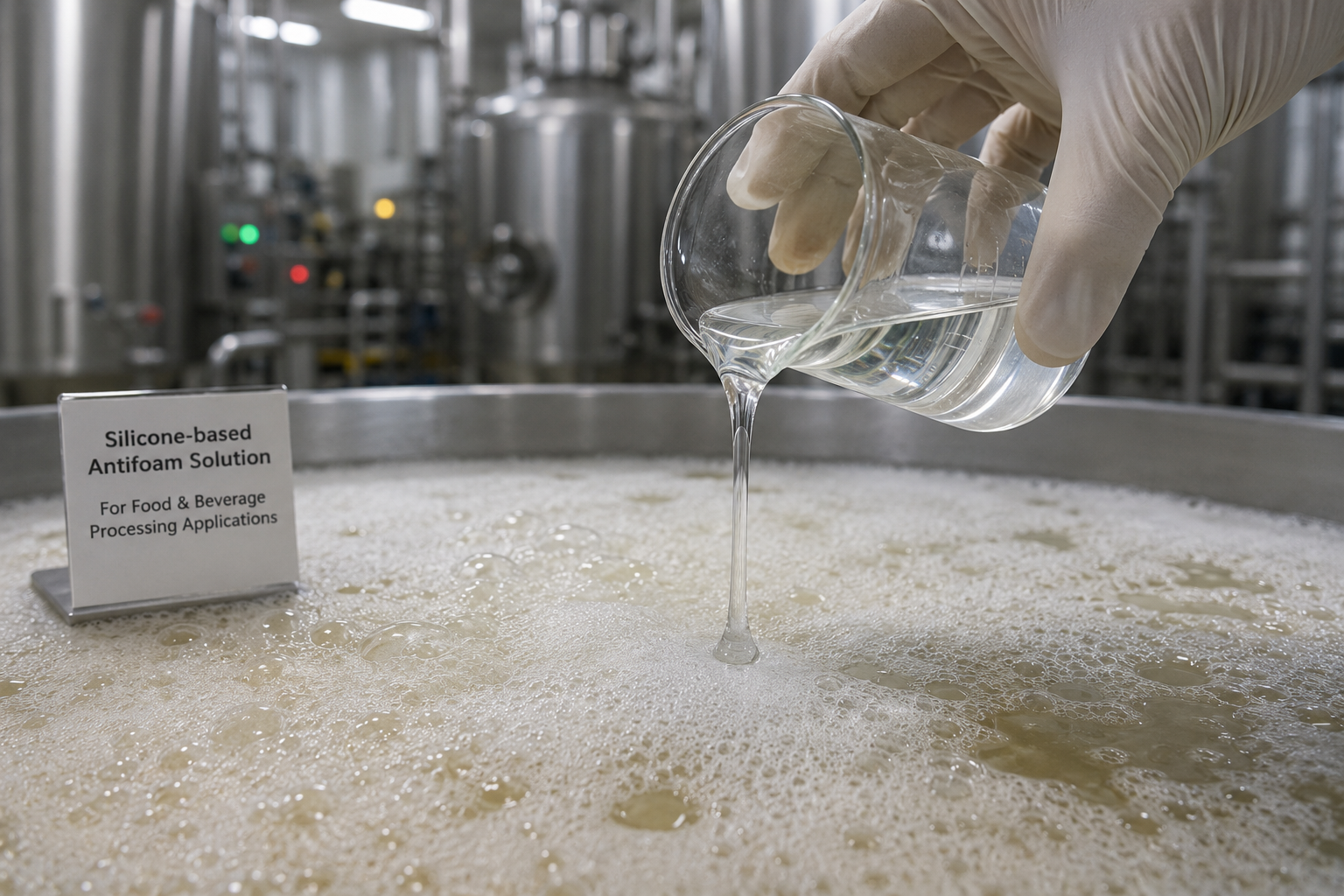
Silicone-based antifoams are the most widely used in food and beverage applications because they work at very low dosage levels, typically between 10 and 200 parts per million. They are chemically inert, do not react with process components, and provide long-lasting foam suppression. Silicone’s ability to rapidly spread across a liquid surface and destabilize foam films makes it particularly effective in high-temperature processes and fermentation systems with high protein content.
Oil-based defoamers use a carrier oil such as mineral oil, vegetable oil, or white oil, combined with hydrophobic silica or waxes. They perform well in systems where silicone compatibility is a concern, or where the process requires a more gradual defoaming action. They are commonly used in citric acid production and certain enzyme fermentation processes.
Water-based defoamers are best suited as deaerators, removing entrained air rather than breaking surface foam. They are often used in beverage bottling lines and food mixing systems where dissolved air creates texture and stability problems rather than visible foam overflow.
One thing that is often overlooked: silicone-based defoamers used in EU markets are now subject to the European Union Deforestation Regulation (EUDR), which affects products derived from soybean oil and palm oil. We have proactively transitioned our relevant product lines to rapeseed oil derivatives, which are not only EUDR-compliant but also carry lower GMO risk and reduced allergen concerns. If you source defoamers for European markets, this compliance consideration should be part of your supplier conversation.
What Happens When Foam Control Is Done Wrong
Selecting the wrong defoamer, or dosing it incorrectly, creates problems that go beyond the foam itself. Over-dosing a silicone antifoam in fermentation can suppress microbial activity, reduce fermentation efficiency, and impact the flavor profile of the final product. Under-dosing results in foam overflow, product loss, and potential contamination.
Using a food-grade product in an industrial process is a cost issue. Food-grade formulations carry higher manufacturing costs that are unnecessary when the application does not require them. Conversely, using an industrial-grade defoamer in food contact applications is a compliance and safety failure.
Timing is another factor most operators get wrong. Adding an antifoam too early in a fermentation cycle, before the foam-active period begins, wastes product. Adding it too late leads to vessel overflow before the antifoam has time to spread and act. In automated yeast plants, electrode-activated dosing systems are used precisely because manual dosing is too imprecise for consistent results.
How We Approach Foam Control for Food and Beverage Clients
Based in Kingwood, Texas, we supply foam control solutions to food and beverage manufacturers across more than 50 countries, including major markets in South America, India, Southeast Asia, and Europe. Our distribution and technical network is structured to provide not just product supply but application-specific guidance, because the same defoamer recommended for citric acid production in Brazil will not necessarily perform the same way in a rum distillery in the Caribbean.
Our full foam control range covers antibiotics, Baker’s yeast, citric acid, enzymes, glutamic acid, gasohol, molasses, rum production, sugar juice, torula yeast, and general yeast processing. We supply both food-grade (FG) and manufacturing-grade (MFG) silicone formulations, as well as organic-based defoamers for processes where silicone is not suitable.
Every application we work on starts with understanding the process: raw material composition, operating temperatures, fermentation strain, regulatory requirements, and target product quality. That evaluation determines which chemistry, which form (emulsion, neat liquid, or dilutable concentrate), and which dosage protocol is appropriate.
For food and beverage manufacturers looking to reduce product loss, improve batch consistency, and keep foam from becoming a recurring operational problem, explore our full antifoam and defoamer product range or learn more about how we deliver solutions across industries and geographies.
Frequently Asked Questions
Are food-grade defoamers required for all food and beverage applications?
Not always, but they are required wherever the defoamer comes into direct or indirect contact with the food product itself. In fermentation processes where the product is consumed, such as yeast, citric acid, antibiotics, or beverages, food-grade certification is non-negotiable. In cleaning-in-place (CIP) systems or external cooling circuits, industrial-grade formulations may be acceptable depending on local regulations.
Can the wrong antifoam damage fermentation performance?
Yes. Silicone antifoams at excessive dosage levels can coat yeast cell membranes, reduce oxygen transfer efficiency in aerobic fermentations, and interfere with normal microbial metabolism. Some antifoams also contain components that act as mild biocides, which can suppress the microbial culture you are trying to grow. Correct dosage and chemistry selection are both critical.
What is the difference between antifoam and defoamer in practical terms?
An antifoam is preventive. It is dosed into the process before foam forms to stop it building up. A defoamer is corrective. It is added to an active foam to collapse it quickly. Both may use similar chemistries, but their physical form, concentration, and spreading speed are often different. Many operations use them in combination.
Why do some processes require organic-based defoamers instead of silicone?
In distillation processes such as rum, ethanol, and whiskey production, silicone contamination of the distillate can affect flavor, clarity, and regulatory compliance. Organic-based defoamers like our QEMI DF 8322 are used in these applications because they do not carry silicone into the vapor stream and do not affect the sensory profile of the final spirit or fuel-grade alcohol.
How do EUDR regulations affect foam control product sourcing in 2026?
The EUDR, which came into full effect in late 2024, requires that soy and palm-derived ingredients used in products sold or manufactured in the EU be traceable and free from deforestation. Since many defoamers are manufactured using soybean oil or palm oil derivatives, suppliers who have not transitioned their supply chain may create compliance exposure for their customers. We have already transitioned the relevant lines in our range to rapeseed-based alternatives.
Summary
Foam in food and beverage processing is a chemistry problem, not just an operational inconvenience. The right foam control chemical, matched to the process, the raw material, and the regulatory environment, protects yield, product quality, equipment, and compliance. Getting it wrong costs more than the defoamer ever would.
At Qemi International Inc, we bring over 37 years of specialty chemical experience to foam control applications across the food and beverage sector. From fermentation to sugar processing to yeast manufacturing, we supply application-specific silicone, oil-based, and water-based solutions with the logistics and documentation support to reach operations anywhere in the world. Explore our foam control solutions to find the right fit for your process or contact us through our website today!